
OpenAI has overhauled ChatGPT’s voice mode. The old Advanced Voice Mode is being replaced by GPT-Live, a new generation of voice models that can listen and speak at the same time instead of forcing the strict, walkie-talkie-style turn-taking of the old system. Announced on July 8, 2026 in an official blog post titled “Introducing GPT-Live,” it is rolling out now to everyone over the next few days in the ChatGPT apps for iOS and Android and on the web at chatgpt.com. Tap the Voice button to try it.
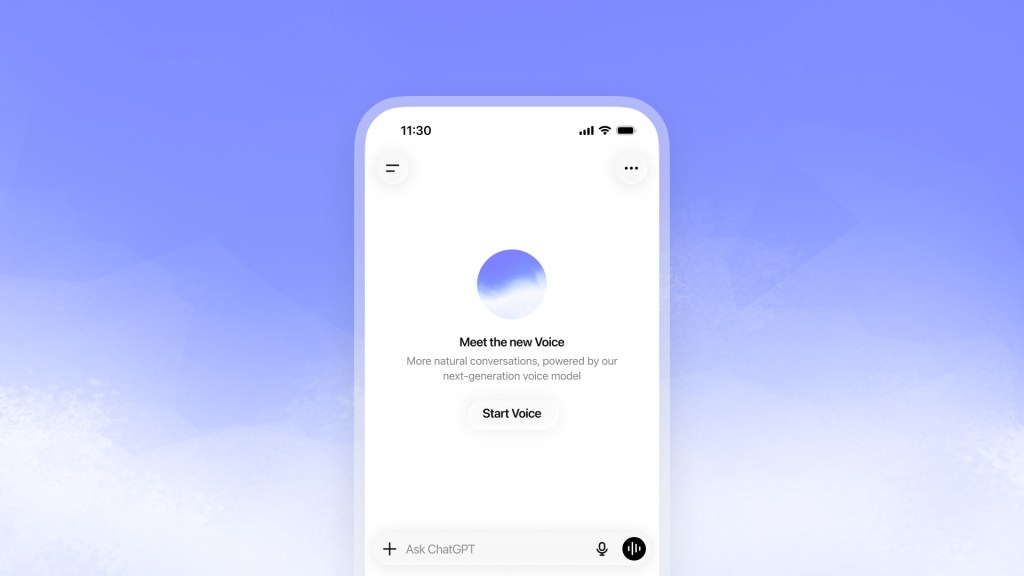
There are two versions. GPT-Live-1 mini is the new default for Free users, while the full GPT-Live-1 is the default for paying subscribers on ChatGPT Go, Plus, and Pro. OpenAI says more than 150 million people use ChatGPT’s Voice and Dictation features every week.
What makes the new ChatGPT voice mode different
The old voice mode chained together three separate steps: speech-to-text, then the language model, then text-to-speech. That pipeline forced you to wait your turn. GPT-Live merges those steps into a single “full-duplex” system that processes audio and decides when to speak, listen, pause, or let itself be interrupted many times per second.
In practice, that means you can cut in mid-response naturally, and the assistant can make small sounds like “mhmm” or “yeah” while it listens, the way a person would. For harder questions that need a live web search or deeper reasoning, GPT-Live hands off to OpenAI’s GPT-5.5 model in the background and brings the answer back into the spoken conversation once it is ready. The models use “GPT-5.5 Instant” by default, with Medium and High variants that switch to “GPT-5.5 Thinking.”
Real-time translation and on-screen cards
Two new features stand out. GPT-Live can do real-time simultaneous translation between languages during a live conversation, something OpenAI says the old turn-based system could not do. It can also show visual response cards mid-conversation for things like weather, stock prices, sports scores, and charts, though OpenAI notes those may take a day or two to reach all users.
A note for Indian users on Hindi translation
The translation feature is a headline addition, but early hands-on impressions suggest quality varies by language. Reviewers (reported by TechCrunch and BigGo) noted that when GPT-Live translated English into Hindi, the output carried a noticeably heavy American accent and sounded stilted and formal rather than natural. This is an early observation, not something OpenAI has claimed, so treat it as a first look rather than a verdict.
Safety and how OpenAI rates it
OpenAI says it has added expanded safeguards around self-harm, psychosis, violence, and sexual content, plus age-appropriate responses, parental controls, and routing to crisis hotlines for self-harm conversations. On performance, in OpenAI’s own blind testing of matched 5-10 minute conversations, users reportedly preferred GPT-Live-1 over the old mode 75.7% of the time and GPT-Live-1 mini 69.2% of the time (reported by the-decoder). That is an internal comparison, not an independent benchmark.
Product lead Atty Eleti told TechCrunch that “voice can be the future interface to all kinds of work.”
The rest of it, in brief
- A wake phrase, “Hey Chat,” reportedly lets the assistant stay silent until directly addressed (per BigGo).
- Nine revamped voice options are reportedly available at launch (per the-decoder).
- Video and screen-sharing support are reportedly coming to GPT-Live soon (per the-decoder).
When will you get it?
The rollout started on July 8 and continues to all users globally over the next few days, so you may not see it immediately. Open the ChatGPT app on iOS or Android, or go to chatgpt.com, and tap the Voice button. API access for developers is not available yet; OpenAI has a notify-me form and says it is coming soon.
Sources: OpenAI, TechCrunch, the-decoder, BigGo
