
Google has pulled the AI image generation feature it added to Google Earth just a day earlier, after researchers showed it would happily produce convincing fake satellite imagery of real places. The button is gone from Google Earth on the web, and Google says it is working on stronger guardrails — without committing to whether or when the feature returns.
What the Google Earth AI image feature actually did
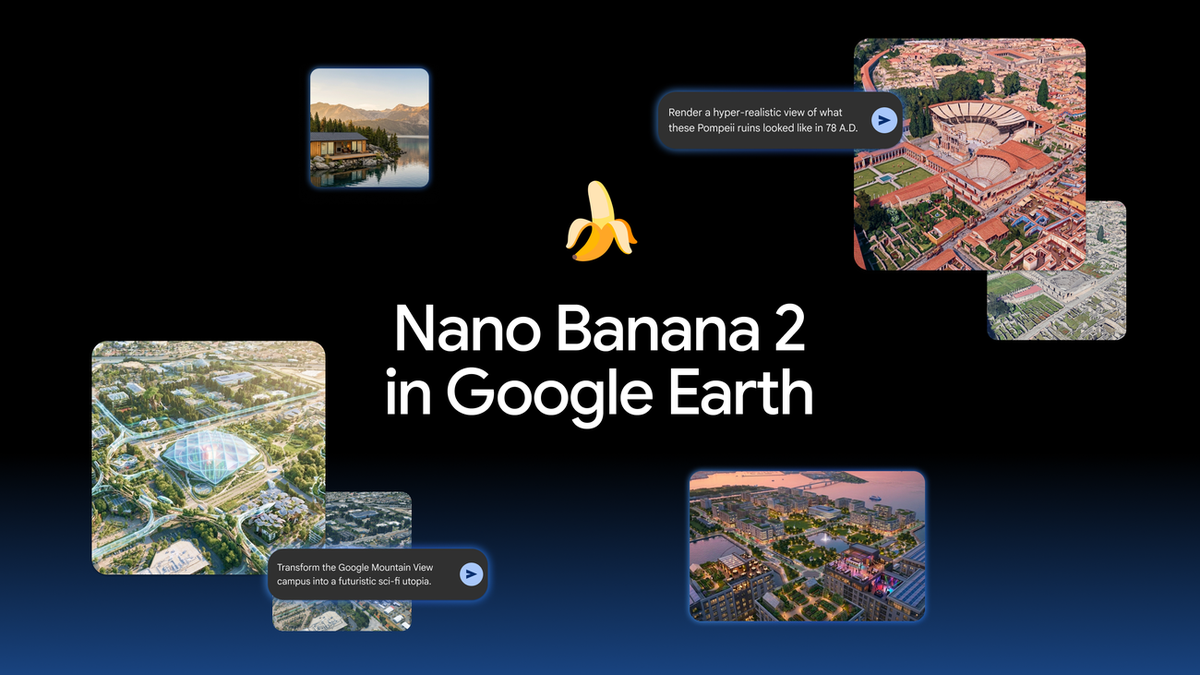
Announced on 30 July by Bryan Horowitz, a product manager on Google Earth, the feature wired Google’s Nano Banana 2 image model into Earth’s satellite, aerial and 3D imagery. Google’s instructions were about as simple as they sound: zoom in to a place in Google Earth on the web, tap create image, and type whatever you wanted to see. It went live globally the same day, India included, for anyone using Google Earth in a browser.
The launch post pitched five uses: rendering Pompeii as it looked in 78 A.D. for a classroom, generating infographics about a landmark, mocking up a real estate development on an empty lot, previewing a lakeside house before construction, and turning a place into a sci-fi cityscape for fun. All of that is real and reasonably useful.
Why it lasted about 24 hours
The problem is that the free-text prompt applied to real coordinates as well as imaginary ones. Open-source researcher Henk van Ess, who first flagged the risk, told NPR he tested refugees at the Mexican border, a nuclear plant in Iran, a plane crash in Amsterdam and a hospital with a bomb crater in Gaza, and told NPR that nothing he tried was refused. NPR’s own reporters generated Iran’s Kharg Island oil terminal on fire and a flooded US Capitol complex — neither of which happened.
That matters more than the usual AI-slop complaint. Satellite imagery is one of the few remaining classes of evidence that journalists and investigators treat as hard to fake, precisely because the cameras are owned by a handful of institutions and sit hundreds of kilometres up. A one-click generator that starts from genuine Google Earth imagery erodes that in a way a general-purpose image model does not.
Google updated its blog post on 31 July:
We know that people uniquely trust Google Earth for a reliable view of the world. We’ve seen geospatial professionals using this feature for a range of useful purposes, however we’ve also seen people sharing screenshots of generated imagery that appear to violate our policies. So we’re rolling back this feature in Google Earth while we work on implementing stronger guardrails.
The safeguards Google is pointing to
The same update adds that generated images never appeared in the main Google Earth experience for other people to see, and were watermarked as AI generated. Both are true, and both are beside the point the company’s own statement concedes: what spread were screenshots. A screenshot carries no invisible provenance signal, and a visible watermark is a crop away from gone. Google has effectively acknowledged that its safeguard was defeated by the most obvious behaviour a user could exhibit.
Worth saying plainly, since Google’s framing leans on the professional use cases: a tool capable of putting a burning oil terminal on a real island shipped to every Google Earth web user on the planet before anyone appears to have asked whether it should. The rollback is the right call. That it took a day and an outside researcher, rather than an internal review, is the part Google has not explained.
What this means for you
Anything you generated was never visible to other people inside Google Earth, going by Google’s own statement — though the company has not said whether it keeps those images or for how long. If you were using the feature for architecture mockups or teaching, it is paused rather than cancelled; Google describes the rollback as lasting while it works on stronger guardrails, but has committed to no return date. And the broader habit is worth keeping: a “satellite photo” circulating on WhatsApp or X is no longer self-verifying evidence. Check whether a named imagery provider and a capture date are attached before you believe it.
For a related look at how AI products leak things users assumed were private, see our piece on Claude shared chats turning up in Google Search.
