
Framework has refreshed its smallest and cheapest machine. The new Framework Laptop 12 swaps the original’s 13th Gen Intel chips for Intel’s Core Series 3 processors, adds Thunderbolt 4 on two of its four Expansion Card slots, moves to Wi-Fi 7, and — new for this generation — can be bought with Fedora Linux already installed. Pre-orders opened on 18 August 2026.
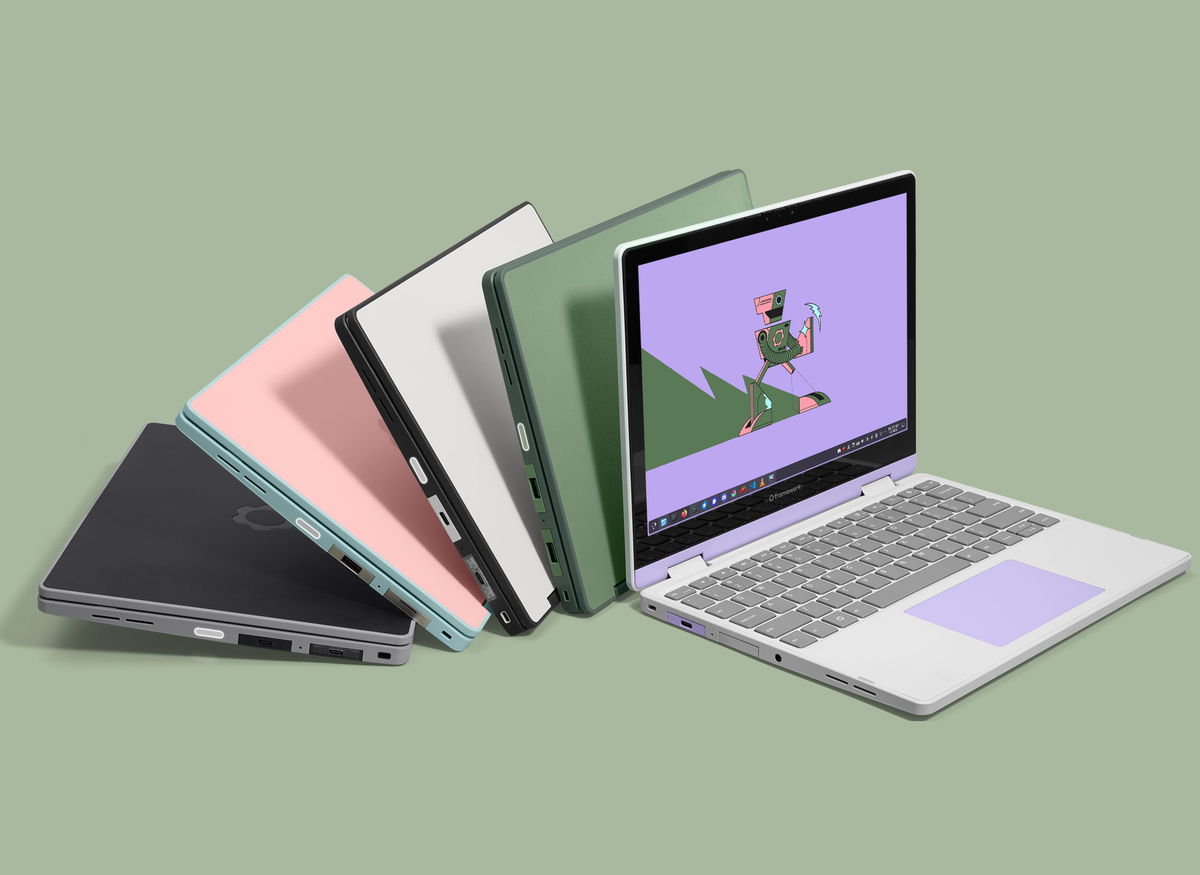
The shell is unchanged: the same 12.2-inch convertible touchscreen with stylus support, the same five colourways, and the same repairability that is the whole point of the company. What’s different is what’s inside it, and Framework says the new mainboard, fingerprint reader and backlit input cover are all backwards compatible with the original Laptop 12 — so existing owners can buy the parts instead of the laptop.
What’s new in the Framework Laptop 12
Core Series 3 is Intel’s entry-level platform, but Framework’s argument is that it isn’t a cut-down architecture. In its announcement the company calls it a shrunk-down version of the Core Ultra Series 3 platform used in the Framework Laptop 13 Pro — the same Cougar Cove P-cores, Darkmont LP-E cores and Xe3 graphics, in lower core counts, on the same Intel 18A process.
Framework’s own early testing, which it attributes to a Core 5 320 configuration, claims a 70% increase in Netflix 4K streaming battery life over the Core i5-1334U in the original Laptop 12. That is a vendor number from a single streaming test, not an independent review, so treat it as a direction rather than a figure to buy on.
- Ports: the two rear Expansion Card slots now do Thunderbolt 4, enough for an eGPU or two 4K 60Hz displays. The two front slots drop to USB 3.2 Gen 2; all four still accept power for charging.
- Memory: DDR5 up to 6400 MT/s, still a user-replaceable SO-DIMM, up to 64GB.
- Storage: modular M.2 2230 NVMe, up to 2TB.
- Wireless: Wi-Fi 7 R2 using Intel’s BE213, on a replaceable M.2 module.
- Fingerprint reader: built into the power button, on Core 5 and Core 7 configurations only.
- Backlit keyboard: a new option, running open-source ZMK firmware on a reprogrammable controller. Standard on the Fedora pre-built Core 5 and Core 7 machines, an add-on for any DIY Edition.
Linux out of the box, and why
The headline change for the site’s Linux readers is that Framework will ship pre-built configurations with Fedora 44 KDE Plasma Desktop already installed. The company says almost 80% of Framework Laptop 12 owners already run Linux, which is an unusually blunt reason to bother.
“It’s really exciting to see this device become the first Framework device to ship with KDE and Plasma software. We have put a lot of effort into making sure our software is fun to use with touch and pen input.” — Aleix Pol, President of KDE e.V., quoted in Framework’s announcement
One caveat matters if you plan to install your own distro: because Core Series 3 and the BE213 radio are both new, Framework says you need kernel 7.1 or newer. Fingerprint support has been added to libfprint, and the company is seeding pre-release hardware to CachyOS and Bazzite as well. If your distro of choice is on an older kernel, wait for it to catch up before ordering. It is worth reading this alongside our look at Linux desktop market share claims — vendors shipping Linux by default is a far better signal than any tracker.
Pricing and availability
Framework has announced US dollar pricing only. Pre-orders are open now on Framework’s own store. Framework’s announcement says Batch 1 ships in October; the configurator currently shows Batch 2 for new orders, so check the batch label on the option you pick before ordering.
- DIY Edition, Core 3 304: $549 — up to 4.3GHz, 5 cores (1P + 4 LP-E)
- DIY Edition, Core 5 320: $779 — up to 4.6GHz, 6 cores (2P + 4 LP-E)
- DIY Edition, Core 7 350: $999 — up to 4.8GHz, 6 cores (2P + 4 LP-E)
- Pre-built with Fedora Linux: from $699
- Original 13th Gen Laptop 12, DIY Edition: now from $499
Read the DIY prices carefully. Memory, storage and the operating system are all listed as separate choices in Framework’s configurator, so $549 is a barebones starting point, not the price of a finished laptop. Framework has not announced India pricing or an India launch, and there is no rupee figure to quote — check the shipping destinations on Framework’s own store before you plan around one, and treat any converted price you see elsewhere as guesswork.
The pitch that survives all of that is the one Framework keeps making and most of the industry still won’t: you can buy the mainboard on its own, put it in a laptop you already own, and keep the screen, chassis and keyboard you paid for last year. Framework frames this as keeping a computer that respects your rights affordable in a volatile silicon market — self-serving, but it is also the only laptop pitch on the market where “upgrade” doesn’t mean “buy another one”.
Source: Framework
